Connected intelligence for remote operations
How Edge AI Vision and Hybrid IoT can transform decision-making beyond traditional network boundaries
Featuring the Twinberry Farms field validation initiative with M2M Tech and Terrestar Solutions
Connected intelligence for remote operations
Twinberry Farms field validation
Edge AI Vision + Hybrid IoT
Growers, remote operators, innovators and IoT ecosystem partners
Executive summary
Remote operations are becoming more data-driven, more automated and more dependent than ever on precise and timely information. Yet many of the places where operational data is generated have unreliable connectivity coverage: farms, forests, mines, construction sites, energy infrastructure, transportation routes and other distributed environments.
This whitepaper introduces the concept of Connected Intelligence for Remote Operations: an operating model where cameras, sensors and a variety of machines collect field data. Edge AI transforms that data into actionable insight close to the source, while Hybrid.
IoT connectivity helps deliver the right information to operators, dashboards and business systems beyond traditional network boundaries. The Twinberry Farms field validation initiative provides a practical proof point. In this initiative, M2M Tech’s MEA platform brings Edge AI Vision to blueberry harvesting operations, while Terrestar’s Hybrid IoT connectivity extends the reach of data-driven insight through cellular and satellite connectivity. Together, they demonstrate how connected intelligence can improve visibility, decision-making speed, productivity and confidence in remote operations.
Every little bit of insight is going to help us grow as a business.
Farmers will always adopt something when they can see the value it brings to them.
Key takeaways
Connected intelligence turns remote field data into practical, timely operational insight.
Edge AI creates intelligence close to machinery, sensors and field data.
Hybrid IoT extends intelligence beyond traditional network boundaries.
Twinberry Farms provides a practical validation environment, not a theoretical showcase.
This model supports agriculture and other remote operations.
1. Why connected intelligence matters now
Remote operations no longer suffer from insufficient data. Cameras, sensors, machines and field systems are already capturing what happens on the ground. The real challenge is turning those signals into precise, timely, actionable intelligence, especially in places where connectivity is unreliable, operations are mobile and decisions cannot wait for perfect network conditions.
That’s where Terrestar’s Hybrid IoT becomes a strategic enabler. By combining cellular and satellite connectivity, organizations can now extend the reach of operational insights beyond traditional network boundaries. When paired with M2M Tech’s Edge AI, intelligence is created closer to the source, transmitted more efficiently and delivered where it can support decision-making and action.
For Canadian industries such as agriculture, forestry, mining, energy, transportation and northern operations, this model is becoming essential, as it helps reduce blind spots, improves responsiveness and makes advanced technology usable in the field, not only in controlled environments.
The Twinberry Farms initiative brings this model to life. Edge AI Vision interprets what is happening on the harvester. Terrestar’s Hybrid IoT helps move key insights across cellular and satellite networks. Together, they show how Connected Intelligence can support real-time decision-making in real-world operating conditions.
2. A new operating model for remote operations
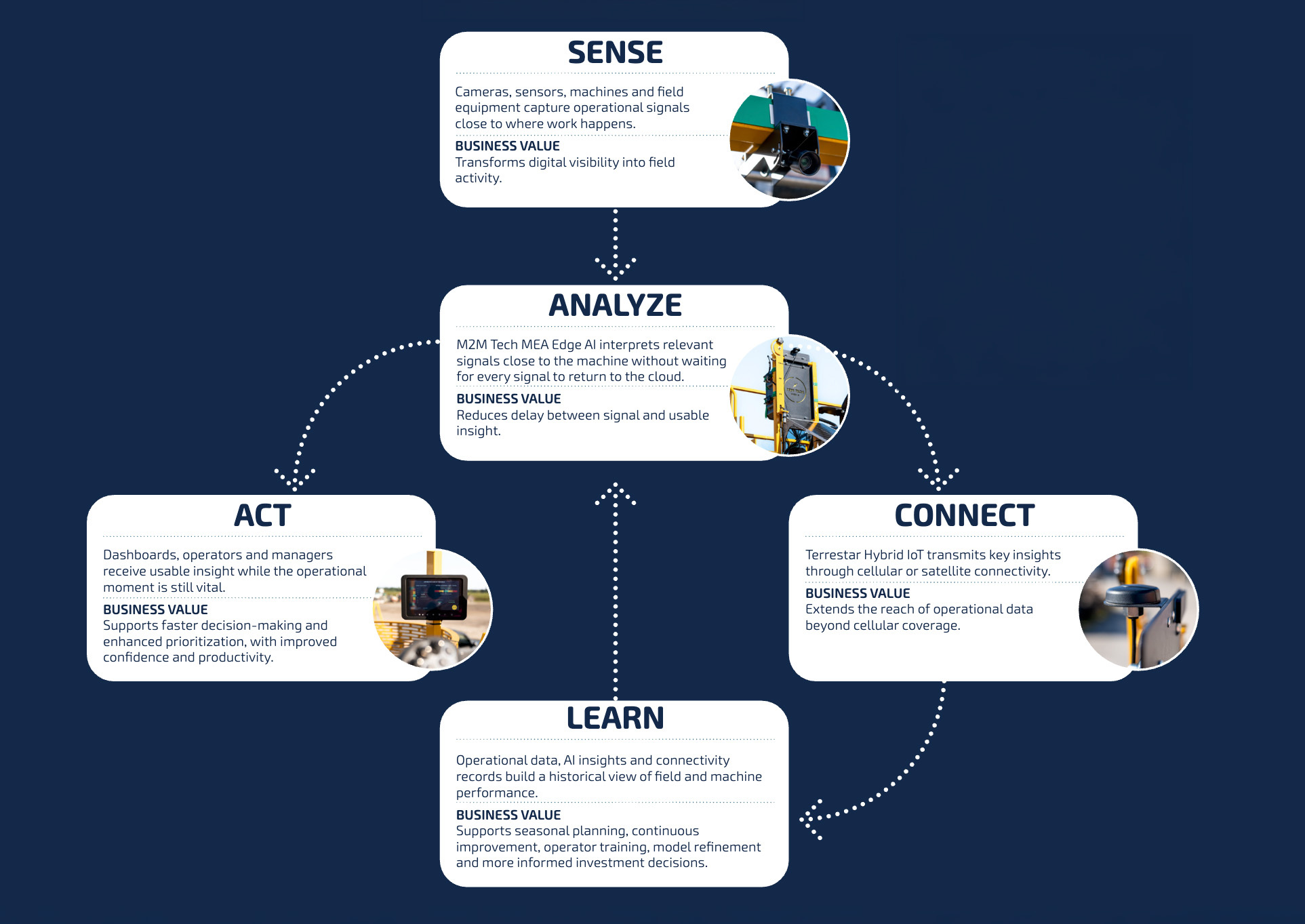
Connected Intelligence combines sensing, analysis, connectivity, action and learning into a singular and highly powerful operating model. Cameras, sensors, machines and field equipment capture what is happening: Edge AI interprets relevant signals close to the source; Hybrid IoT carries the right insights through cellular or satellite connectivity; and operators, managers or business systems use those insights to act. The value lies not in the creation of more data but in shortening the path and the time from field signal to operational action.
This model is especially relevant for operations that are mobile, seasonal, remote, and safety- and/or time-sensitive. In environments like these, delayed information can translate into lost productivity, missed quality signals, avoidable travel, compromised employee safety, equipment downt
3. The Twinberry Farms validation: turning field data into field decisions
Agriculture is one of the clearest environments for validating connected intelligence. Field operations are spread across large outdoor areas. Work is seasonal and time-sensitive. Weather, labour, equipment performance and crop quality can change quickly. Producers need practical insights, not technological complexity.
Twinberry Farms provides an ideal example of that real-world validation environment. Harvest operations bring together machines, crews, weather, crop quality and tight delivery windows. A typical day can involve monitoring fields, assessing berry readiness, preparing harvesters, coordinating teams, responding to equipment issues and moving fruit quickly from the field to customers.
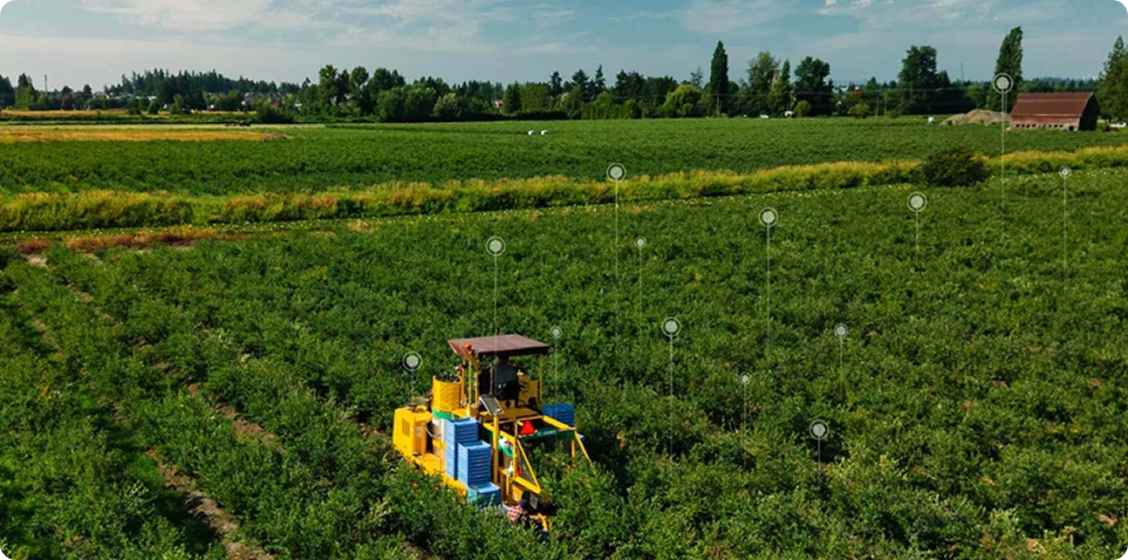
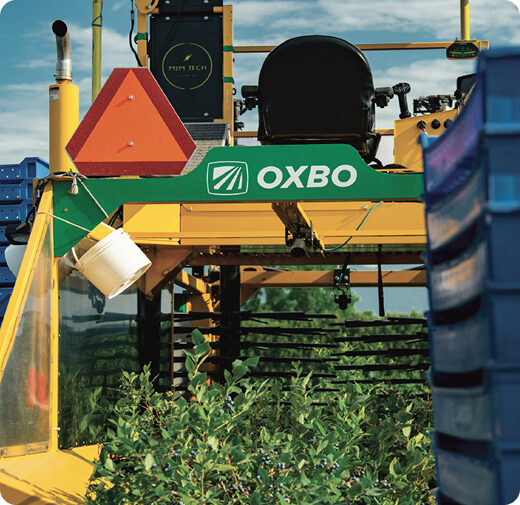
Our initiative connects this operating reality with M2M Tech’s MEA Edge AI Vision platform and Terrestar’s Hybrid IoT connectivity. The process is clear: a dual-camera AI vision system detects blueberry ripeness ahead of the machine and assesses post-harvest execution behind it. In the cab, a live touch display turns edge AI detections into immediate visual prompts, helping the operator adjust comb speeds and maintain precise bush alignment.
Terrestar’s Hybrid IoT provides the reach layer. Cellular coverage is used when available, and switches to satellite connectivity when needed, helping move compact event data from field equipment to cloud dashboards and business systems beyond traditional network boundaries. A key design lesson from Twinberry is that intelligence must be both precise and usable. The MEA Edge Vision system continuously classifies ripeness and bush alignment, but the solution is designed so it doesn’t overload the operator with every micro-variation. Instead, 20-second control loops and 30-second stability filters smooth the stream of edge AI inferences into stable, human-friendly guidance. This helps prevent over-correction, reduces operator fatigue and supports more consistent harvest execution in real field conditions.
We bring sovereign edge AI as close as possible to the source of truth, which is the data itself.
I think the biggest difficulty is that we can’t be everywhere all at once. Typically, there is a lot of information that we can’t assess in real time, and we have to be physically in the fields. We would like to have data that is in our hands.
4. What connected Intelligence is designed to improve
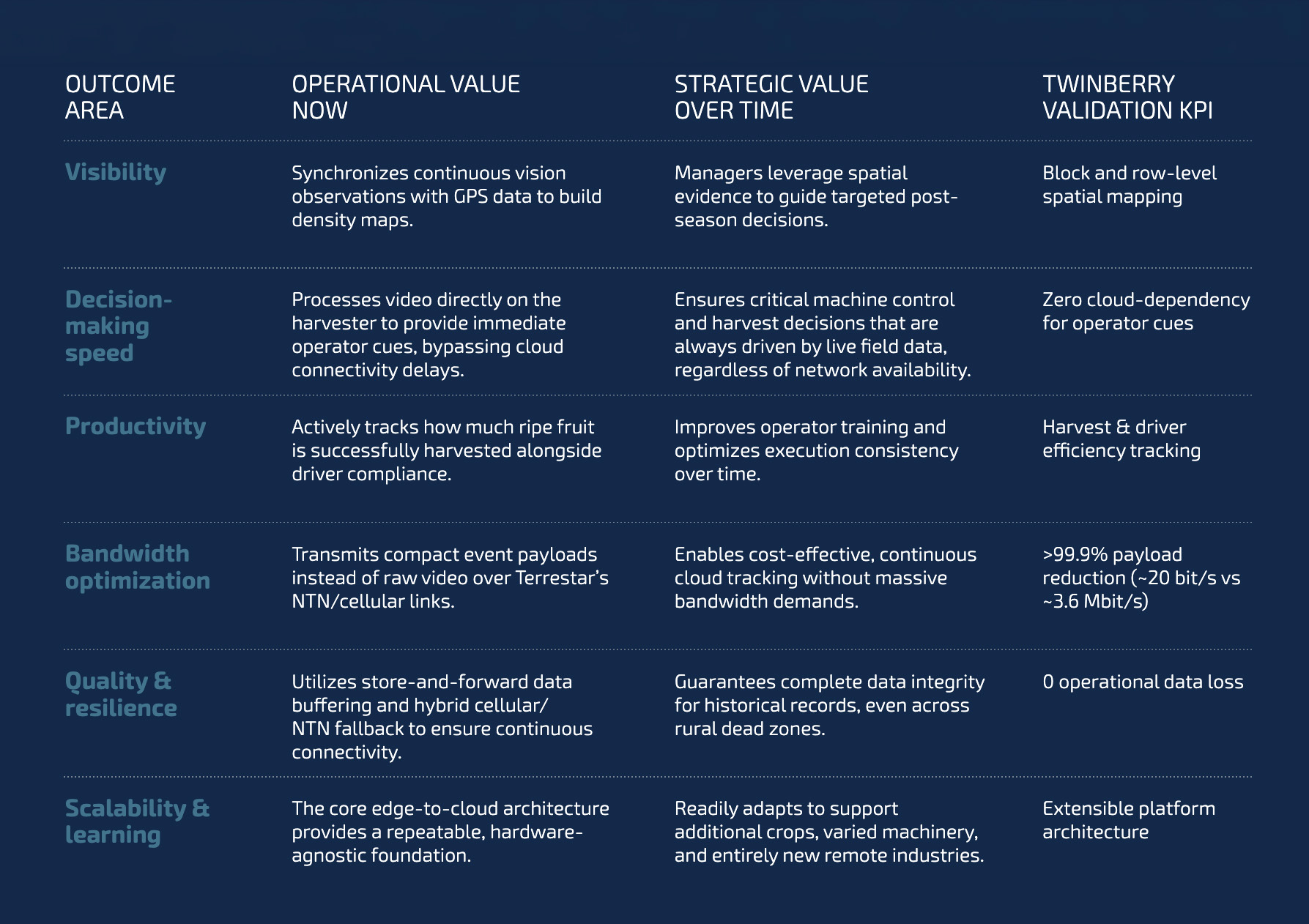
The more compelling story isn’t the technical architecture. It’s the operational outcome. Connected Intelligence is useful when it improves visibility, responsiveness, productivity, quality, resilience and scalability for the people running the operation.
Rahul Singh’s from the BC Centre for Agritech Innovation sees farmers and producers adopting technologies when the value is practical, visible and connected to ROI. In other words, the question is not whether AI or IoT is an innovation. It’s whether the combined solution helps the operation perform better.
Connected Intelligence creates value on two different time horizons. The first is operational: helping teams make better decisions while the work is actually underway. The second is strategic: helping organizations learn from accumulated data over weeks, seasons and years. Real-time visibility can improve day-to-day execution, while historical data and AI-driven insights can support planning, investment decisions, operational improvement and long-term growth.
AI and IoT on the harvester can improve efficiency, support increased production, reduce waste and help accelerate broader adoption across
5. Beyond agriculture: a repeatable model for remote industries
Twinberry Farms is the proof point, but the operating model extends well beyond agriculture. Any organization that operates equipment, assets, people or infrastructure outside reliable network coverage can face the same challenge: field data exists, but it is delayed, fragmented or disconnected from the decision-maker.
By combining Edge AI and Hybrid IoT, organizations can reduce operational guesswork, improve visibility in field conditions and extend access to critical insights beyond traditional network boundaries. The same model can support agriculture, livestock, mining, construction, energy, utilities, forestry, wildfire monitoring, transportation, logistics, critical infrastructure and more.
For Canada, this is a practical innovation story. Many strategically important industries operate across rural, remote and hard-to-reach regions. Connected Intelligence makes advanced technology usable beyond urban centres by bringing intelligence closer to the worksite and extending the reach of that intelligence through hybrid connectivity.
While this pilot focuses on agriculture, the solution was designed for any business that requires reliable and continuous connectivity.